Understanding the word congruent is essential in mathematics, geometry, logic, communication, and even everyday life. Although the term is commonly used in academics, it plays a major role in describing agreement, alignment, harmony, and equality in various contexts.
Whether you’re a student trying to understand geometric concepts, a writer refining communication, or simply someone wanting to improve vocabulary, learning what congruent truly means can be incredibly useful.
This comprehensive guide explains the meaning of congruent, its usage in different fields, real-life examples, common misconceptions, and why it is such an important concept. By the end, you will understand not only what congruent means but also how to use it confidently and correctly.
What Does Congruent Mean in General?
The word congruent means in agreement, harmony, or alignment with something else. When two or more things are congruent, they match each other in nature, characteristics, or meaning. In everyday conversation, congruent is used to describe compatibility or consistency.
Examples in simple English:
A person’s words and actions are congruent when they match.
Two ideas are congruent when they support each other.
A statement is congruent with evidence when the evidence proves it.
The term comes from the Latin word congruere, meaning “to come together” or “to agree.” This origin perfectly reflects its modern usage: congruent things come together seamlessly.
Although congruent is used most commonly in mathematics and geometry, its general meaning applies widely. Understanding the root meaning helps make sense of its specialized uses as well.
Congruent in Mathematics
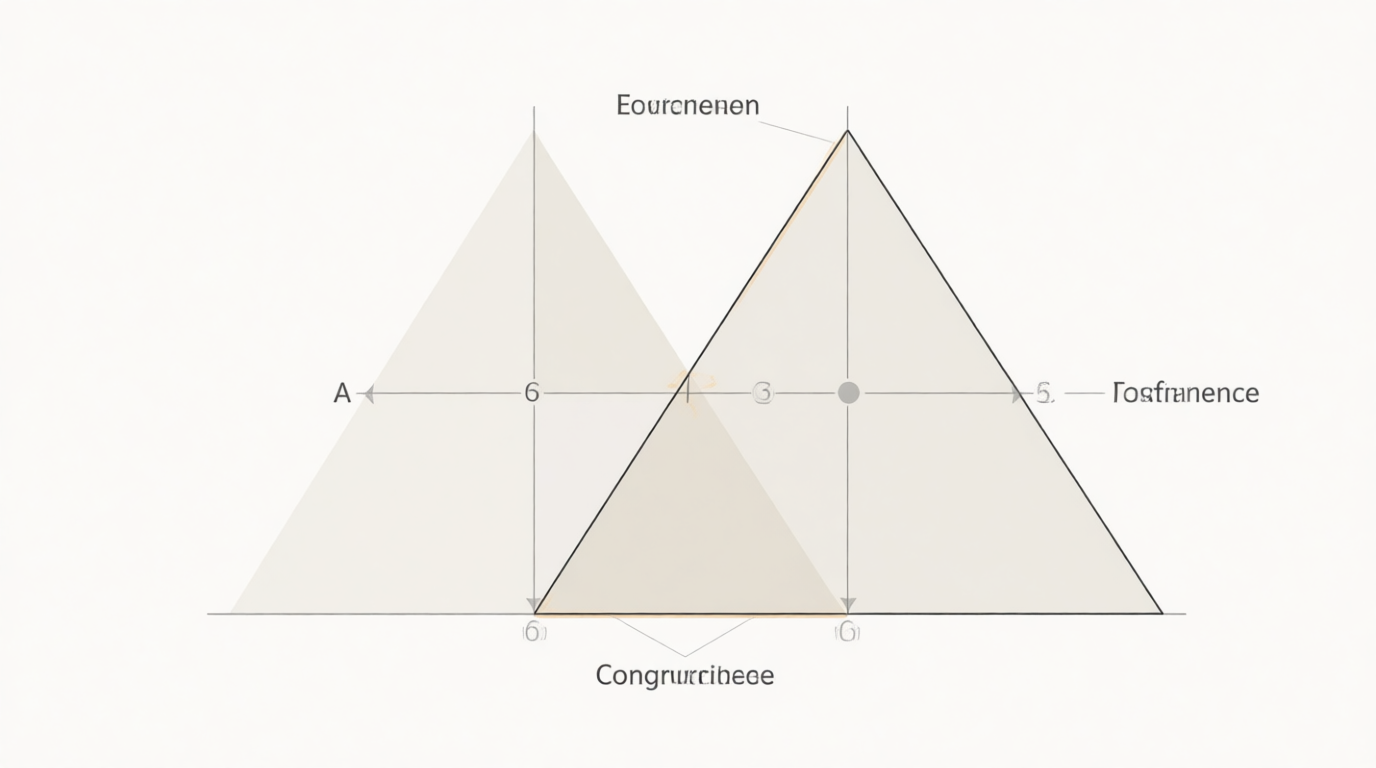
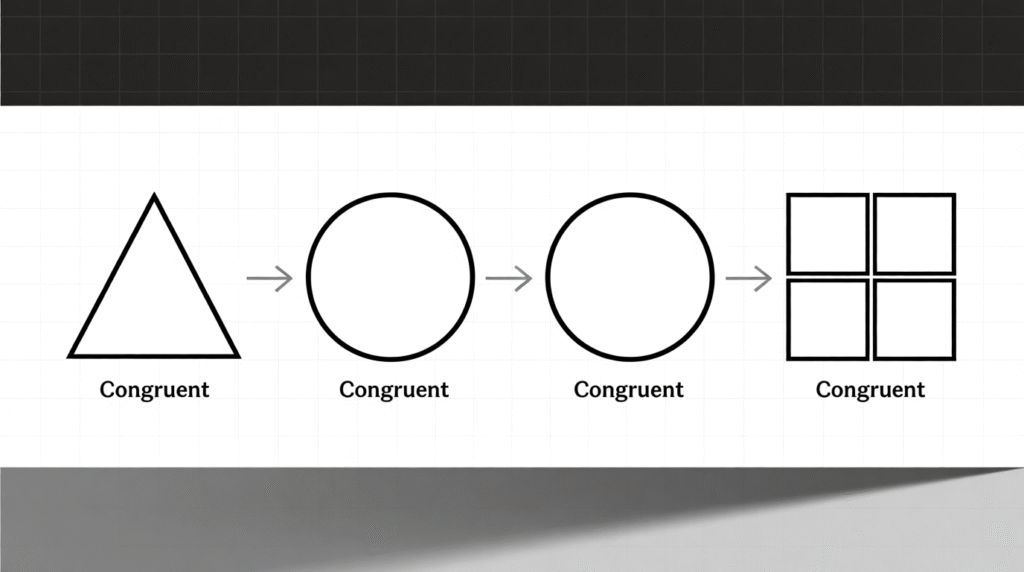
In mathematics, congruent has a specific and precise meaning. Two figures or objects are congruent when they are identical in shape and size, even if they are rotated, flipped, or moved.
Mathematically speaking:
Congruent figures have the same dimensions and the same shape, even though their positions may differ.
This is a fundamental concept in geometry and is often represented using the congruence symbol:
≅
So, if triangle ABC is congruent to triangle DEF, we write:
△ABC ≅ △DEF
This tells us the triangles match exactly in all sides and angles.
Congruent Shapes
When two shapes are congruent:
All their corresponding angles are equal.
All their corresponding sides are equal.
Their overall form is identical.
Shapes may appear in different orientations, but when placed on top of each other, they fit perfectly.
Examples of congruent shapes:
- Two squares with side lengths of 5 cm.
- Two circles with the same radius.
- Two triangles with equal sides and angles.
Because congruent shapes maintain both size and shape, they can be considered geometric “twins.”
Why Congruence Matters in Mathematics
Congruence plays a central role in many mathematical operations, including:
- Proving geometric theorems
- Understanding transformations
- Comparing polygons and angles
- Solving construction problems
Without congruence, many concepts in geometry would not be possible.
Congruent Angles
Angles are congruent when they have the same measure, regardless of how they are oriented or positioned.
Examples:
A 45° angle and another 45° angle are congruent.
Two right angles (90° each) are congruent.
Two straight angles (180°) are congruent.
Even if the angles open in different directions, their measurements determine their congruence.
Why Congruent Angles Are Important
Congruent angles help in:
- Solving triangle problems
- Understanding parallel lines and transversals
- Proving geometric theorems
- Studying symmetry
In geometry, recognizing congruent angles is often the first step to solving larger problems.
Congruence in Triangles
Triangles are one of the most common shapes used to study congruence, and several rules determine whether two triangles are congruent. These rules rely on the equality of sides and angles.
Here are the most widely used congruence criteria:
Side-Side-Side (SSS)
Two triangles are congruent if all three sides are equal in length.
Example:
If triangle ABC has sides 4 cm, 5 cm, and 7 cm and triangle DEF has sides 4 cm, 5 cm, and 7 cm, then:
△ABC ≅ △DEF
Side-Angle-Side (SAS)
Two triangles are congruent if two sides and the included angle are equal.
This means the angle must be between the two matching sides.
Angle-Side-Angle (ASA)
Two triangles are congruent when two angles and the included side are equal.
Angle-Angle-Side (AAS)
Two triangles are congruent when two angles and a non-included side match.
Right Angle-Hypotenuse-Side (RHS)
This criterion applies only to right triangles. A right triangle is congruent to another if:
Both have a right angle
Their hypotenuse is equal
One of their other sides is equal
Why Triangle Congruence Matters
Understanding triangle congruence allows mathematicians and students to:
- Prove geometric theorems
- Establish the equality of other angles or sides
- Analyze structures in engineering and architecture
- Solve real-world measurement problems
Congruent triangles form the backbone of many mathematical proofs.
Congruent vs. Similar: What’s the Difference?
Many people confuse congruent with similar, but the two terms have different meanings in geometry.
Congruent Figures
Same shape
Same size
Can be rotated or flipped
Match perfectly when overlapped
Similar Figures
- Same shape
- Different size (can be scaled up or down)
- Proportional sides
- Equal corresponding angles
Example:
- Two squares of the same size → congruent
- Two squares of different sizes → similar, but not congruent
Understanding this difference is important because congruence is a stronger condition than similarity.
Congruent in Everyday Language
Outside mathematics, congruent means matching, consistent, or in harmony. It is often used to describe ideas, actions, values, or behaviors.
Here are some examples of congruent in everyday conversation:
“His words were not congruent with his actions.”
“The company’s policies are congruent with its mission.”
“Their goals are congruent with our long-term plan.”
“Her beliefs are congruent with her lifestyle.”
In these contexts, congruent describes alignment between things, not physical equality.
This everyday usage is becoming more common, especially in psychology, communication studies, and leadership training.
Congruent in Psychology and Behavior
In psychology, congruent behavior refers to behaving in a way that is consistent with your inner feelings and beliefs. It plays a huge role in emotional well-being and communication.
Examples of Congruence in Psychology
A person who feels sad and expresses sadness is congruent.
A leader whose behavior matches their stated values is congruent.
Someone who hides their emotions may be incongruent.
Why Congruence Matters in Psychology
Congruence promotes:
- Authenticity
- Better communication
- Emotional balance
- Trust in relationships
Therapists often encourage congruent communication to improve mental health and self-understanding.
Congruent in Communication
In communication, congruence refers to the alignment between:
Words
Tone
Facial expressions
Body language
When these elements match, communication is clear and believable.
Example:
If someone says “I’m fine” but their tone is angry, their communication is incongruent. This mismatch can lead to misunderstandings or mistrust.
Congruent communication, on the other hand, strengthens relationships and builds confidence.
Congruent in Logic and Philosophy
In logic, congruence refers to consistency between arguments. When an argument is congruent, its claims do not contradict each other.
Example:
If someone claims that “everyone deserves freedom” but also supports limiting freedom for certain groups, their arguments are incongruent.
Logical congruence is essential for:
Strong arguments
Academic writing
Critical thinking
Ethical reasoning
Real-Life Examples of Congruence
To understand congruence fully, here are some real-life situations where the term applies:
Fashion
Two outfits can be congruent if they match in style, color, or theme.
Architecture
Identical windows or tiles are congruent shapes.
Business
A company’s branding must be congruent across platforms for customers to trust it.
Personal development
People aim for congruence between their goals, values, and behavior.
Relationships
Healthy relationships rely on congruent communication and behavior.
These examples show that congruence is not only a mathematical idea but also a life concept.
Why Understanding Congruence Is Important
Knowing what congruent means can improve your:
Mathematical Skills
Geometry, angles, and triangle proofs become much easier.
Communication
You can express alignment and agreement accurately.
Personal Growth
You can evaluate whether your actions match your values.
Academic Writing
Using the correct term makes your writing clearer and more professional.
Critical Thinking
You can identify inconsistencies in arguments or information.
Congruence is a small word with powerful impact.
Common Misconceptions About Congruence
Even though the concept seems simple, many people misunderstand its meaning. Here are the most common mistakes:
“Congruent means similar.”
False. Congruence requires both identical shape and size. Similarity does not.
“Congruent shapes must look exactly the same.”
They must match in size and shape, but they can be rotated or flipped.
“Congruent only applies to math.”
It is widely used outside mathematics in daily life, communication, psychology, and logic.
“Congruent equals equal.”
In math, equal numbers end at value. Congruent figures match physically, not just numerically.
Understanding these differences helps prevent confusion.
How to Use Congruent in a Sentence
Here are examples covering mathematical, professional, and everyday contexts:
Mathematical Use
“These two triangles are congruent by the SAS rule.”
“The angles formed are congruent because they both measure 60 degrees.”
Professional Use
- “The project is congruent with our long-term strategy.”
- “Their vision is congruent with the company’s mission.”
Everyday Use
- “Her actions are congruent with her beliefs.”
- “Their statements were not congruent with the evidence.”
Using the word correctly enhances both writing and communication.
Final Thoughts
So, what does congruent mean? In simple terms, congruent refers to things that agree, align, or match. In mathematics, it means identical in shape and size. In communication, psychology, and everyday use, it means that elements are consistent and harmonious.
Understanding congruence helps in geometry, improves communication, strengthens relationships, and enhances logical thinking. It is a versatile term with powerful applications.
Whether you are studying mathematics, writing professionally, or improving your interpersonal skills, the concept of congruence will continue to be valuable and relevant.

David is the creative mind behind jokes Crafter, a hub for clever jokes, witty wordplay, and laugh-out-loud content. With a passion for humor and a knack for crafting the perfect punchline, David brings smiles to readers across the globe. When he's not writing, he's probably thinking up his next viral joke or enjoying a good comedy show.
- David

- David
- David
- David
- David
- David
- David
- David
- David
- David